Human health - allergies
Study
The following is a study detailing the safety of GMO crops. The EFSA GMO Panel assessed the safety of Cry1Ac protein in the context of various GM plants applications (Table 1). It is noted that the EFSA GMO Panel assessed different variants of the Cry1Ac proteins, all fully characterised in structure and function, and did not identify concerns regarding the safety of any of them. In particular, the allergenicity assessmentof all Cry1Acprotein varietns was performed in line with the principles described in Codex Alimentarius gu [...]
Question
In what ways can GMO products benefit people's health?
Submitted by: Sergio Avila
Answer
Expert response from Community Manager
Moderator for GMOAnswers.com
Friday, 25/01/2019 21:52
GM crops like high oleic soybeans provide higher levels of oxidative stability. These soybeans contain 20 percent less saturated fat than commodity soybean oil and extend the shelf life for packaged food products, eliminating the need for artificial preservatives. You can learn more about the high oleic soybean on DuPont Pioneer’s website here.
In this response, Connie Diekman, RD, discussed two non-commercial products that may one day provide significant health benefits:
"Since GMO technology can boost crop yield that can be viewed as a health benefit but in terms of direct health benefits the health benefits of these crops lies in the traditional nutrition that they contain. GM crops do not differ in nutritional or health benefits from non-GM crops so including them in your eating plan can help your overall nutrition.
There are two products that would provide real health benefits, one is Golden Rice, a rice that is fortified with vitamin A, and the other is SDA oil. SDA is an oil that will allow plant-based omega-3 fatty acids in the oil to be available to the body for use more efficiently.
So when you ask ‘How do GMOS’ benefit Health’ the answer is a bit tricky but the bottom-line is that all of the plants that are GM provide nutritional benefits and that certainly benefits health.”
In addition to benefiting your health, GM crops also benefit your wallet. In this response, Dr. Stuart Smyth discusses how GM crops help to stabilize/reduce food prices:
“As farmers produce higher yield, this helps keep prices stable and any price increase would be lower than the case where there was a shortage of any commodity. In an assessment I led a few years ago (Smyth, Kerr and Phillips, 2015), we found that the level of benefits to consumers varied from a five percent at the low end, to 53 percent. On average, consumers experience about 20 percent of the benefits from GM crops in the form of lower food prices.”
If you are looking for more information, be sure to check out this response about the benefit of GMOs on society.
From environmental sustainability to nutritional benefits, we’ve outlined 5 Ways GMOs benefit society’s health here.
We hope this answers your question.
Study
The allergenicity of genetically modified foods from genetically engineered crops
The following is an introduction and conclusion of a study published in the journal Annals of Allergy, Asthma & Immunology assessing the claim that GMOs can cause allergies. Introduction During the past 2 decades, the diagnosis of food allergy has increased in industrialized countries. Immunoglobulin E (IgE) food allergies affect an estimated 4% to 8% of the American population.1,2 The reason for this increase remains unclear, but food allergy has become an increasingly difficult challenge for patients and their physicians to manage. Repeated exposures lead to signifi [...]
Infographics and Downloadables

Infographics and Downloadables
Do GMOs Cause Allergies?

No, GMOs do not cause allergies. Lisa Katic, a Registered Dietitian and President of K Consulting, explains that, “No commercially available crops contain allergens that have been created by genetically engineering a seed or plant. And the rigorous testing process ensures that that will never happen.”
She also notes, “food allergies are mainly caused by eight major foods (milk, eggs, peanuts, tree nuts, soy, wheat, fish and shellfish) and account for about 90% of reported food allergies in the United States. First, it is important to note that only one of these eight major allergens listed above is a potential product of biotechnology – soy. Of the remaining seven allergens listed, none is commercially available in genetically modified varieties.”
So they don’t cause allergies themselves, but are GMOs causing an increase in allergies?
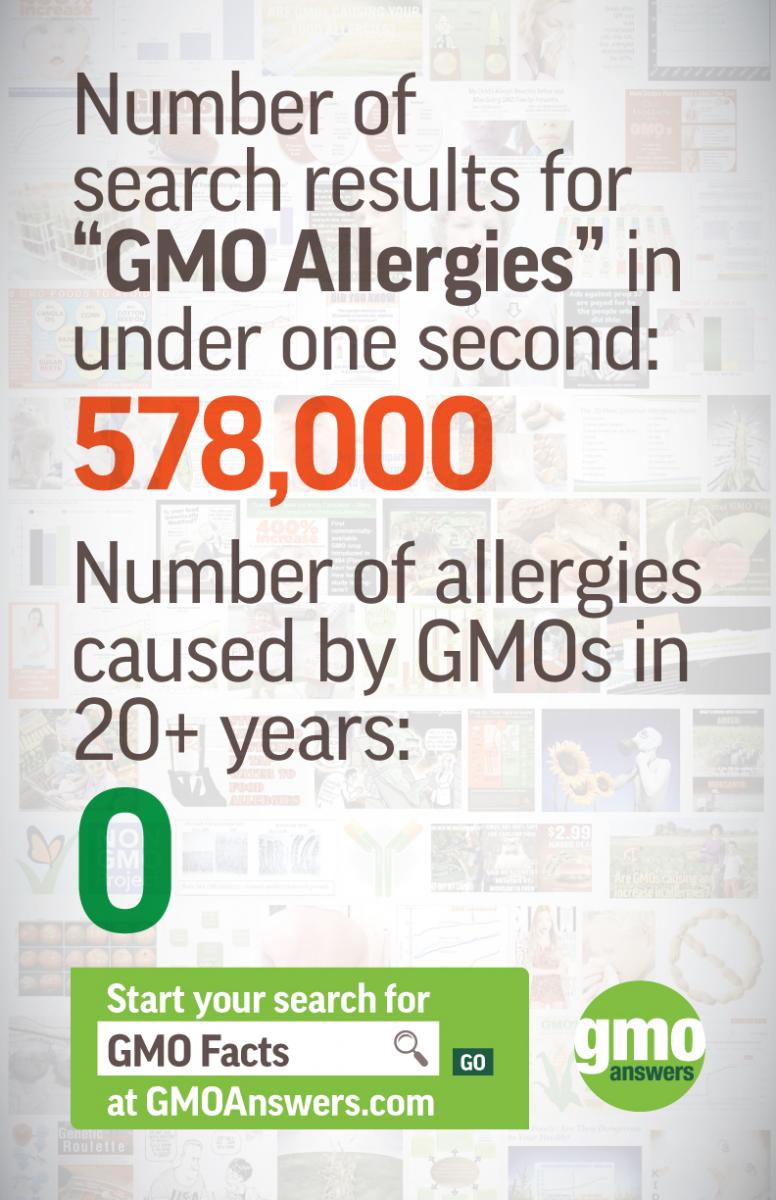
Unless a specific crop is modified to have enhanced nutritional content, food from GMO crops has the same nutritional value as food from non-GMO crops and is digested in the body in the exact same way. Available foods from GMO crops are as safe as foods from conventional crops and the introduced protein(s) are tested to avoid introducing an allergen. Since 1996, when GMO crops have been commercially available in the United States, there has not been a single documented instance of harm to human health resulting from genetic modification, including allergic reactions.
If a person is allergic to a non-GM plant, he or she will also be allergic to the plant’s GMO counterpart but it isn’t the GMO itself that’s causing the allergic reaction. For example, if a person is allergic to soy, then they will be allergic to GMO, non-GMO and organically produced soy. GMOs do not introduce any new allergens, so there is no such thing as a ‘GMO allergic reaction’.
How might GMOs solve food allergies?
Contrary to the belief that GMOs cause allergies, researchers, academics, and companies are working on new GMOs that have the potential to help people with food allergies or food sensitivity. For example, a gluten-free wheat that is digestible by patients with celiac disease is currently being researched. In the future we could discover more GMO opportunities that could remedy food allergies and allow some of us to eat the things our taste buds love, but the rest of our body does not.
How are GMOs tested for allergies?
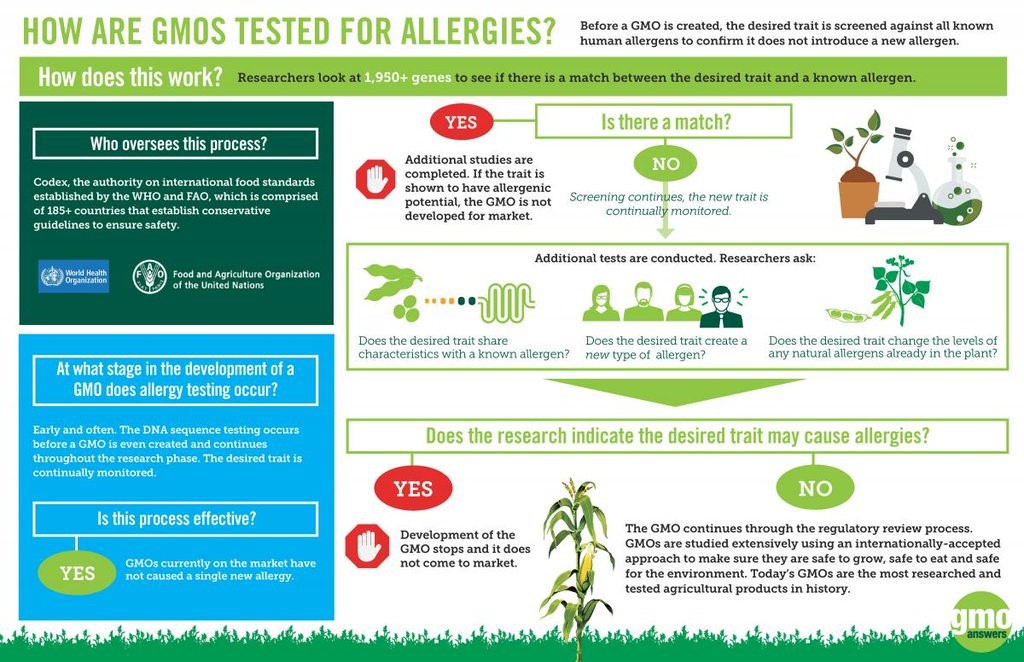
Before a GMO is created, the desired trait is screened and tested against all known human allergies to confirm that it does not introduce a new allergen. Check out this infographic to learn how researchers review over 1,950 genes to ensure quality and safety.