GMO Basics
Article
The Top Five Things About GMOs That People Cared About in 2020
The world experienced a lot of change in 2020. From lockdowns and the impact of the COVID global pandemic to contentious elections, the normal we all knew is irrevocably changed. Based on 2020 data, here are five areas where consumers and their relationship to, or interest in, GMOs changed, and what about GMOs they were most interested in.
Infographics and Downloadables
Article
GMOs in Medicine and Pharmaceuticals
GMOs go far beyond just plants and food. The time-tested technology has resulted in numerous improvements in industries and applications. Learn how GMOs make an impact in medicine and pharmaceuticals.

Question
Answer
Expert response from Amy Johnson
P.hD., DNP, FNP-C
Friday, 02/08/2019 22:14
GMO’s are not dangerous to humans. GMO’s are the most safety-tested food in the world. Prior to being produced, they undergo extensive testing to ensure that there is no risk to humans, animals or the environment. This testing is done by the U.S. Food and Drug Administration (FDA), U.S. Environmental Protection Agency (EPA) and the U.S. Department of Agriculture (USDA). Some of this testing includes the potential for a GMO to cause new food allergies in addition to testing nutritional quality. There have been no proven cases of disease or illnesses linked to GMO’s anywhere in the world. As a healthcare provider, I appreciate the opinion of other healthcare providers – The American Medical Association and the American Academy of Pediatrics have both agreed that GMO’s are safe for all humans. The more important focus is making sure that you are eating a variety of healthy, nutritious food.
Answer
Q: Are chemicals or drugs used?
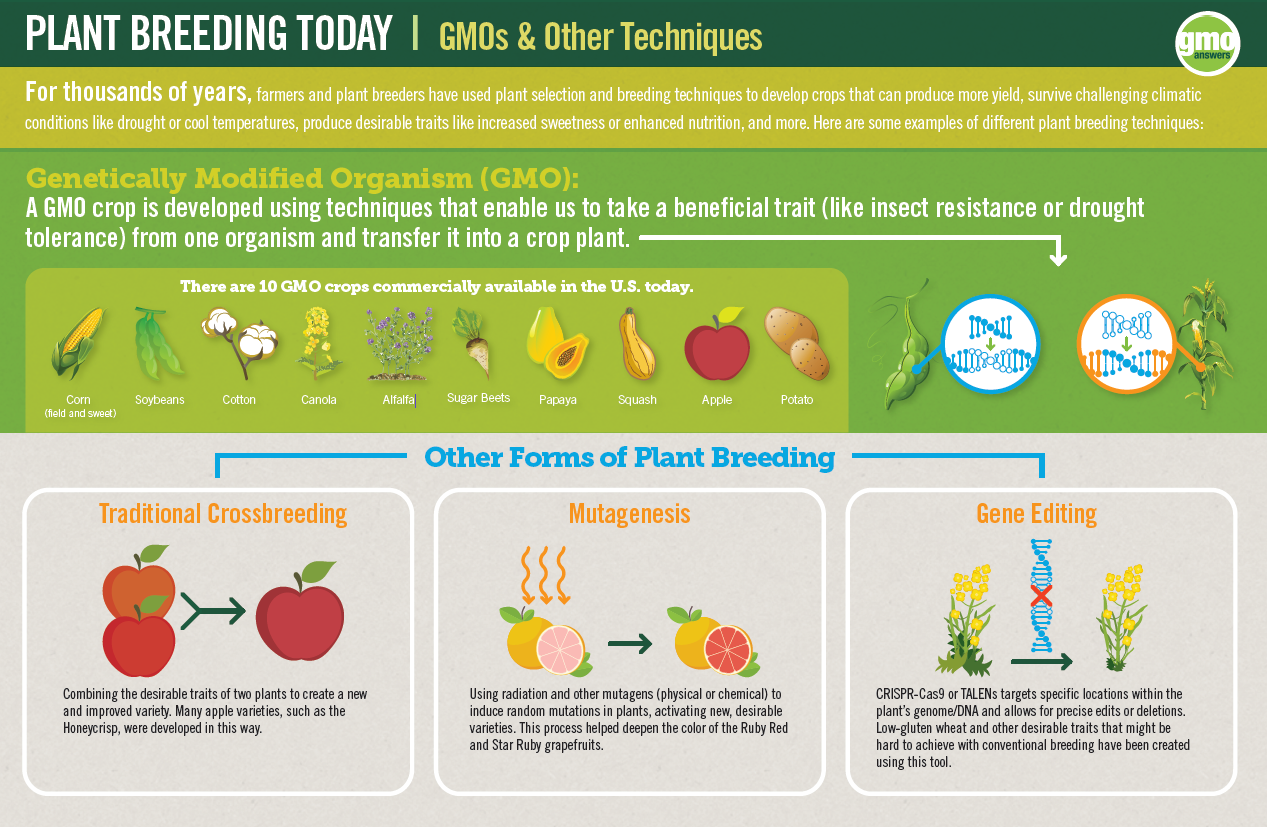
A: There are many breeding techniques utilized in modern agriculture including selective breeding, mutagenesis and genetic engineering, among others. Beginning in the 1920s, plant breeders started seeking more diversity than they were able to achieve through selective breeding to create new traits. Through mutagenesis they began to make changes in plant deoxyribonucleic acid (DNA) by exposing seeds to chemicals or gamma irradiation and then selecting the plants that displayed the traits they wanted. More than 3,200 varieties of commonly consumed plant products have been developed using mutag [...]
GMO BasicsAnswer
A: A hybrid is a plant that is the result of crossing two species or varieties. Hybridization can happen naturally, but is most often an intentional way to select traits from two plants with the goal of maximizing those in the offspring plant. This process can be part of traditional plant breeding methods, but some hybrids are also GM crops if either one or both parents used in a cross are transgenic plants. For example, corn is one of the most widely hybridized crops in the world, and farmers have been using hybrid corn varieties for about a century. Using biotechnology, breeders can also ad [...]
GMO BasicsAnswer
Q: why do some experts choose not to engage in genetic modification
A: I think that you are referring to the technique of genetic engineering. Scientific disciplines are wide and varied. Just within the agricultural space alone there are all kinds of experts such as plant breeders, plant geneticists, plant biochemists and more that work to develop new plant and crop varieties. Some use conventional breeding techniques while others use genetic engineering tools. The technique used depends upon research objectives, goals, resources, timing, etc. The chart below compares and contrasts modern methods of seed improvement. It’s important to [...]
GMO BasicsAnswer
Q: What are the disadvantages of GM foods?
A: Nothing is ever perfect. As Rob Wager, faculty member at Vancouver Island University explains in a previous response, “GM crops have been quite successful since they arrived on the market 20 years ago … That is not to say there are no significant issues — there most definitely are. However, when one looks at the legitimate issues with GM crops, the vast majority are not unique to GM crops and are equally applicable to other forms of agriculture.” He cites a few common issues, including high seed and regulatory costs, germ-line biodiversity, cross-pollination, fertilizer use and herbicid [...]
GMO BasicsAnswer
A: No, dead animals are not fed to live animals to make GMOs. In fact, no commercial GM crops on the market today even contain “animal genes.” Posted below is a four-minute video that offers a great visual illustration of how GMOs are researched, developed and tested. We hope this answers your question, if you have any other questions about GMOs or biotechnology, please ask here! [...]
GMO Basics