Health and Safety
Question
Is genetically modified foods ultimately bad for humans?
Submitted by:
Answer
Expert response from Community Manager
Moderator for GMOAnswers.com
Thursday, 09/05/2019 19:39
GMOs are safe to eat. That is the overwhelming consensus of scientific experts and major scientific authorities around the world, including the World Health Organization, United Nations Food and Agriculture Organization and American Medical Association. In fact, there have been more than 1,700 studies on the safety of GMOs, hundreds of which were independently funded.
In the spring of 2016, a panel of more than 20 scientists, researchers, agricultural and industry experts with the National Academies of Science, Engineering and Medicine (NAS) reviewed over 20 years of data since GMOs were introduced, including nearly 900 studies and tests and European and North American health data and concluded – as other previous research concluded – that genetically modified crops are safe to eat, have the same nutrition and composition as non-genetically modified crops and have no links to new allergies, cancer, celiac or other diseases. Read the full report here.

Genetically modified food products and food ingredients have been evaluated and approved for food and feed import globally and consumed for 20 years with zero food safety incidents.
We hope this answers your question, if you have any other questions about GMOs or biotechnology, please ask!
Article
GMOs are NOT “As Seen on Social Media”
The following is an excerpt of a Medium post authored by Molly Knudsen, RDN that examines some of the most common GMO myths found online and explains how GMO foods fit into a healthy diet. Raise your hand if you’ve ever felt personally victimized by GMOs? In the food world, GMOs (aka genetically modified organisms) are often depicted as the Mean Girls character Regina George. Claims appear on websites, blogs, social media, and news stations that link GMOs to cancer, antibiotic-resistance, and allergies. But what if these harmful claims, much like the rumors spread through Regina Geor [...]
Answer
A: The published literature contains many badly conducted or outright disingenuous studies that are generated to support preconceived objectives or philosophies. Equally many books on GMOs cite unpublished "studies" that cannot be verified or reviewed. You do not give the actual reference so I cannot specifically comment on the study cited, but as an editor of a major toxicology journal and a previous general manager of the risk assessment Branch of a major food authority I can say categorically that I have not seen a single credible study from any source that demonstrates evidence of adver [...]
Health and SafetyQuestion
In what ways can GMO crops benefit societys health?
Submitted by: Sergio Avila
Answer
Expert response from Community Manager
Moderator for GMOAnswers.com
Friday, 25/01/2019 21:46
GMOs have had a positive impact on society’s health in multiple ways, including advancements in food waste reduction, sustainability, and food security. Although there is a long list, we have boiled it down to 4 main points.
4 Ways GMOs Benefit Society’s Health
1. GMOs can increase the health and nutritional benefits of our food
Rice is an important staple food source for more than half of the world’s population and accounts for between 30-72% of the energy intake across Asia alone. GMO rice, or ‘Golden Rice,’ which gets its name from its yellow color, is more nutritious than rice that isn’t genetically modified since it’s packed with beta-carotene, a rich source of vitamin A. Vitamin A Deficiency is a known cause of death and blindness in the developing world – one which ‘Golden Rice’ can help address. Recently, the U.S. FDA approved Golden Rice – marking the third positive international assessment of this GMO crop and taking us one step closer to helping the people who need it most.
Genetically modified high oleic soybeans with an enhanced oil profile, much like olive oil, have been developed and are longer lasting and trans-fat free. Another example is the Innate potato that has lower levels of asparagine, which when heated, turns into acrylamide, a probable carcinogen.
2. GMOs help reduce food waste
Through a variety of options, GMOs can help reduce food waste and loss. According to the Food and Agriculture Organization, globally, almost half of all fruits and vegetables are wasted every year, including 3.7 trillion apples. GM apples are non-browning, eliminating those superficial issues that cause people to unnecessarily throw them away.
To learn more about non-browning apples and how they reduce food waste, we encourage you to watch this video.

3. GMOs reduce agriculturally related greenhouse gas (GHG) emissions.
Agricultural economist Graham Brookes reports that since the first widespread commercial use of GM crops in the mid-1990s, GM technology has, “facilitated important cuts in fuel use and tillage changes, resulting in a significant reduction in the release of greenhouse gas emissions from the GM cropping area. In 2015, this was equivalent to removing 11.9 million cars from the roads.”
4. GMOs conserve water.
Farmers utilize many tools to conserve water, including drip irrigation systems and conservation tillage practices. GMOs provide another tool that farmers can employ to help conserve water. Herbicide tolerant GM crops along with conservation tillage aid in soil moisture retention, which can reduce the need to irrigate. But, GMOs can help reduce water use in another way – drought tolerance. This GM trait can help crops cope with stress and yield more when periods of drought occur– without supplemental water from irrigation.
5. GMO technology also has potential to improve the lives of millions in the developing world.
Jim Gaffney, Strategy Lead for Biotech Affairs and Regulatory at DuPont Pioneer, provides this insight:
“While serving in the Peace Corps in Cameroon, Central Africa and more recently in business travel to Africa, I’ve observed the difference that technology can make. The average yield of U.S. maize is 165 bushels per acre; the average yield for the African continent is closer to 20 bushels per acre. We can do better in Africa and in most other geographies. GMO technology is one tool to help us get there while enabling farmers a chance at greater sustainability, prosperity, health and nutrition, benefits which have positive and far-reaching ripple effects for all of society.”
As outlined in a study published in 2016 in World Development, farmers in South Africa benefit from yield increases and reduced applications of pesticides with GM maize varieties. The weed control benefits, in particular, are valued by female farmers who most often are tasked with the difficult and time-consuming activity of hand-weeding.
We hope this answers your question, if you have any other questions about GMOs or biotechnology, please ask here!
Question
As someone with a great experience and knowledge about the topic, Do you believe GMO are a better nutritious option than nonGMO crops?
Submitted by: Sergio Avila
Answer
Expert response from Ruth MacDonald
Professor and Chair, Food Science and Human Nutrition, Assistant Dean of Graduate Programs, College of Agriculture and Life Sciences, Iowa State University
Thursday, 27/12/2018 22:09
Genetic engineering has the potential to improve the nutritional quality of foods in many ways. However, unless the trait that is being introduced in a plant or animal is specific for a nutritional target, there is no impact of GMO on nutritional value.
Answer
Expert response from Community Manager
Moderator for GMOAnswers.com
Thursday, 27/12/2018 22:17
In addition to the response by Ruth MacDonald, Professor and Chair, Food Science and Human Nutrition, Assistant Dean of Graduate Programs, College of Agriculture and Life Sciences, Iowa State University, in the spring of 2016, The National Academies of Science, Engineering and Medicine (NAS) issued a report confirming the safety of GMOs and also their compositional and nutritional equivalency with non-GMO foods.
The NAS confirms, “Statistically significant differences in nutrient and chemical composition have been found between GE (genetically engineered) and non-GE plants by using traditional methods of compositional analysis, but the difference have been considered to fall within the range of naturally occurring variation found in currently available non-GE crops.” Click here to read the full report.
In addition, here is an example of a compositional study on GM papaya vs non-GM papaya. The study shows that the levels of vitamins and other nutrients in GM and non-GM papayas are the same.
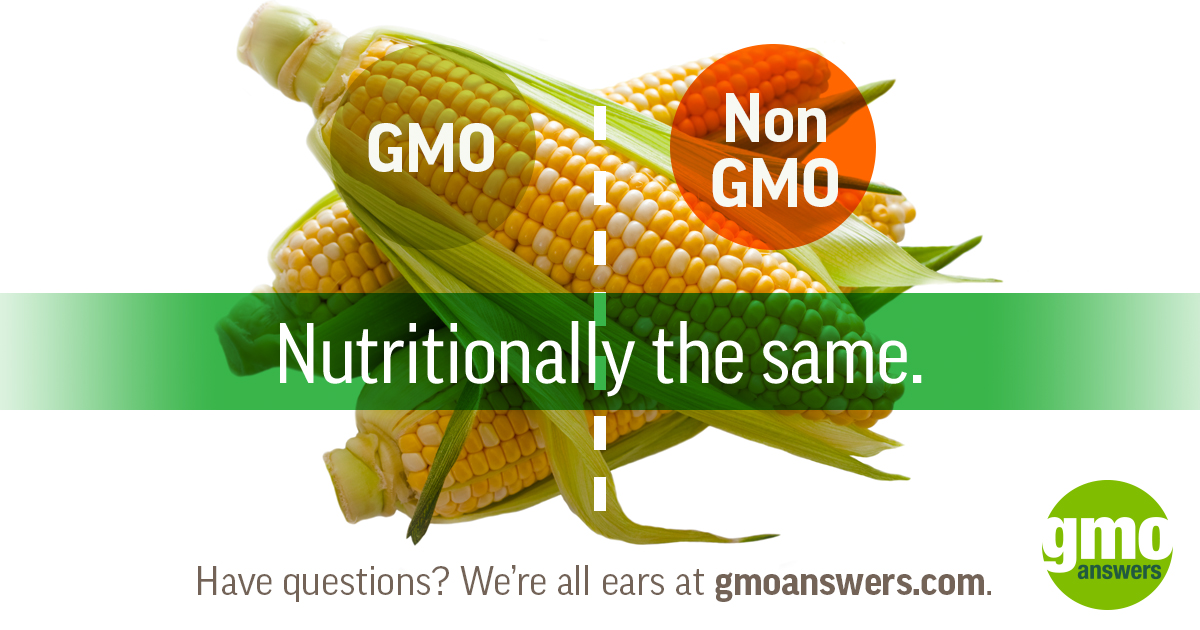
While most GMO crops are nutritionally equivalent to their non-GMO counterpart, enhancing a crop’s nutritional value is one of the many uses of genetic engineering. Genetically modified high oleic soybeans with an enhanced oil profile, much like olive oil, have been developed and are longer lasting and trans-fat free. Another example is the Innate potato that has lower levels of asparagine, which when heated, turns into acrylamide, a potential carcinogen. If a GMO crop’s nutritional content has been intentionally modified, that specific characteristic will be noted on the food package label.
We hope this answers your question, if you have any other questions about GMOs or biotechnology, please ask here!
Study
GM Plant Two Year Saftey Testing
The following are the conclusions and recommendations of research project,"G-TwYST (GM Plant Two Year Saftey Testing)", regarding guidance on the design, conduct, interpretation, and analysis of animal feeding studies and their value for GMO risk assessment funded by The European Commission. Draft conclusions and recommendations 1. Scientific value of rat feeding studies with whole food/feed for GMO risk assessment 1.1. The G-TwYST project provided a broad set of data indicating that the performance of rat feeding trials with whole food/feed for th [...]
Study
An overview of the last 10 years of genetically engineered crop safety research
The following is an abstract and conclusion of a 2013 study in the journal Critical Reviews in Biotechnology that looks at 10 years worth of safety research in genetically modified food and crops. The technology to produce genetically engineered (GE) plants is celebrating its 30th anniversary and one of the major achievements has been the development of GE crops. The safety of GE crops is crucial for their adoption and has been the object of intense research work often ignored in the public debate. We have reviewed the scientific literature on GE crop safety during the last [...]
Answer
Q: what problems are GMOS causing?
A: Thank you for your question. Similar questions have been answered by a variety of experts on our site. Farmer Mary Mertz answered a similar question, “What are the problems with the seeds of GMOs.” She explains how this question can be answered in a variety of ways and also speaks to this topic firsthand, as she is a farmer herself. “In my opinion, the biggest problem with the seeds is the amount of misinformation that is being circulated out there. GMOs have a public image problem. The science-based reality proving GMOs to be safe and nutritious takes a backseat to the emotional p [...]
Human health and safety - general Human Health Health and Safety Health & Safety Environment