GMO Mosquitoes, Bananas and Rice: What We’re Reading – February 2016
In February, we read about the spread of the Zika virus and how a GMO mosquito could be a solution. We also read about GMO rice that can resist the effects of climate change and drought. Curious to learn more? Dive deeper into the latest GMO developments and find out what we’re reading.
Zika Virus and the GMO Mosquito – what you need to know.
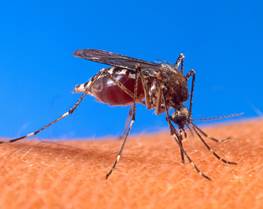 The Zika virus has been linked to thousands of birth defects in Latin America, and it is continuing to spread. The scientific community now is rushing to understand the underlying cause and how to stop the spread of the Zika virus.
Brad Plummer at Vox reports that “Aedes aegypti is the chief villain in the Zika outbreak. This mosquito has a particular taste for human blood, and it's capable of carrying viruses like dengue, yellow fever, chikungunya, and Zika — diseases that immiserate millions.”
Standard methods of mosquito control aren’t working, and many are looking for solutions to help control the spread of Zika. The World Health Institute (WHO) announced that GM mosquitoes could prove necessary to eradicate the Aedes aegypti mosquito that is spreading the Zika virus all around the Western Hemisphere.
Biotech firm, Oxitec, is working on a solution to control the mosquito-borne Zika virus outbreak in Brazil with a genetically modified Aedes aegypti mosquito. Oxitec has developed male mosquitoes that do not produce viable offspring. When the male GM mosquitoes are released into the wild and mate with females – the offspring don’t survive, thereby gradually decimating the overall population.
Field tests of another GMO mosquito related to stopping the spread of dengue fever were implemented in the southeastern Brazilian city of Piracicaba and early results show that this technique killed off 80 percent of mosquitoes in places where it was tested. But the remaining 20 percent mosquitoes may still be enough to sustain disease transmission, or we may face similar threats from another mosquito species like Aedes albopictus. More trials, test and research is needed.
Read the full Vox article, “Can GMO mosquitoes really help us stop Zika? A closer look.”
Do you want to know more about the Zika virus?
Christie Wilcox at Discover Magazine dives into the history and science behind the GMO mosquito and the Zika virus. She finds that there are two main reasons why the GMO mosquito did not cause the Zika virus:
- The Zika virus isn’t new - The first human cases were confirmed in Uganda and Tanzania in 1952. (And there were no GMO mosquitoes in 1952.)
- Male mosquitoes don’t bite people, so they cannot serve as transmission vectors for Zika or any other disease. Since only male mosquitoes are genetically modified, they could not transmit Zika virus.
Dive deeper into the history and science behind the Zika virus in “No, GM Mosquitoes Didn’t Start The Zika Outbreak” at Discover Magazine.
Liz Szabo at USA Today reports on the theory that links pesticides, not Zika, to birth defects. Argentine environmentalists issued a report linking pyriproxyfen, a chemical that kills mosquito larvae, to birth defects. Nevertheless, “Brazil's Ministry of Health rejected any link between the chemical and the microcephaly outbreak, noting the World Health Organization deems pyriproxyfen safe for use as a pesticide.”
Read the full USA Today article, “Scientists debunk theory linking pesticide, not Zika, to birth defects.”
Testing underway of a genetically modified banana with an enhanced nutrition profile.
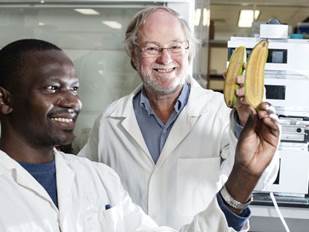 Vitamin A deficiency is a serious health concern in developing countries. The lack of vitamin A can cause blindness, and it can even be fatal. James Dale, an Australian scientist, developed a GMO banana that produces large amounts of beta-carotene, which then turns into vitamin A.
A study of the GMO banana, funded by the Bill and Melinda Gates Foundation, is set to be conducted at Iowa State University to test the safety of the banana.
Want to learn more about the GMO banana and the ISU study? Read The Des Moines Register article on why the Iowa trial of GMO bananas is delayed and this Business Insider article: A group of scientists in Iowa has a desperate plan to prove GMOs are safe.
Greater yield with less pollution: The C4 GMO rice currently in development.
More than 3 billion people depend on rice for food. Unfortunately, rice cultivation is increasingly hindered by climate change since it leads to weather fluctuations and droughts. A new strain of GMO rice in development, called C4, can produce a “greater yield in warmer temperatures while using less water.”
How does GMO C4 rice work? It all comes down to photosynthesis. Rice photosynthesizes through a process known as C3, which is named as such for the three carbon compounds produced when sunlight is absorbed. But C3 isn’t very efficient in terms of saving energy and growth potential. C4 photosynthesis, on the other hand, allows crops to use less water and nitrogen. Common C4 crops include corn and sugar cane. By modifying rice to photosynthesize like a C4 crop, the rice will then be able to grow using less water. Additionally, researchers are also looking to reduce the production of methane, a potent greenhouse gas emitted in rice cultivation.
Read more about GMO C4 rice in this Newsweek article, “Genetically Modified Rice Could Withstand the Ravages of Climate Change.”
Making sense of the science behind GMOs.
With all of these innovative GMO developments, it’s easy to get confused by the science and biotech terminology. To help break down this complex science, this video by piffle explains what a GMO is, and explains the science behind genetic modification.
As always, if you have any questions – please ask!
Get your weekly dose of GMO Answers at Forbes!
 To continue the conversation about GMOs and biotechnology beyond GMOAnswers.com, we are also hosting a column on Forbes.com! Every week, an independent or company expert addresses questions and recent events about all things biotech.
Want to read our recent Forbes posts? Take a look at Why Science Denialism Is Costing Us A Fortune and A Farmer's Letter To A Concerned Student About GMOs.