Question
Has cancer increased since the introduction of GMOs?
Submitted by: Jackie Simmons
Answer
Expert response from Dan Goldstein
Former Senior Science Fellow and Lead, Medical Sciences and Outreach, Monsanto Company
Thursday, 10/09/2014 18:10
Broadly, the answer is no.
U.S. cancer data are readily available to the public for years 1975 through 2012 (as of this writing) in the SEER (Surveillance, Epidemiology, and End Results) database operated by the National Cancer Institute (NCI). Cancer Statistics summaries are also available for those who do not wish to probe the data directly, and to answer this question in more detail, I will refer to the SEER Cancer Statistics Review, 1975–2011 and Cancer Stat Fact Sheets.
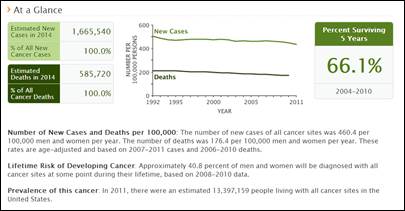
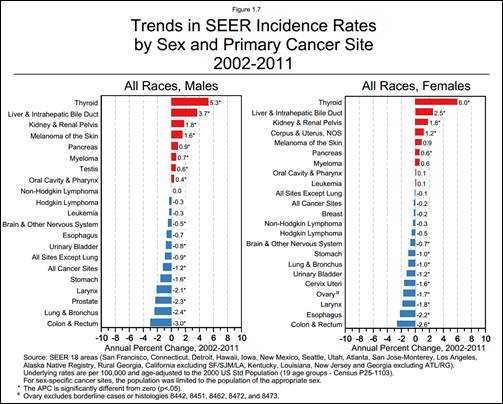
These statistics compile cancer across many different sites—cancer is not a single-disease entity, and the data can be analyzed by sex, age ranges, race and statistical region (city, state or other categories). Unsurprisingly, the overall rate reflects a mixture of increases and decreases in various cancer types. In looking at changes in individual cancer rates, it is important to keep in mind that not all cancer types occur equally—prostate, breast, lung and colorectal cancers are the leading types of cancer—and that cancer incidence rates and cancer death rates often reveal a very different picture. Thus, in the figure below, thyroid incidence rates are increasing but the underlying thyroid cancer death rates (not shown) have remained virtually flat due to improved diagnosis and treatment. Further, thyroid cancers represent only about 3.8% of total cancer diagnoses and 3.2% of cancer deaths (estimated 2014 rates) and have only a small impact on overall cancer incidence and death.
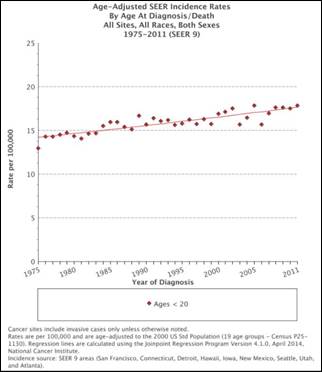
What about children? NCI also compiles rates of childhood cancers but reports them separately, as lifetime cancer rates are small in childhood (about 1 in every 16,000 children) when compared with adult cancer rates (about 1 in 3) and are therefore poorly reflected in overall cancer statistics. The last comprehensive analysis of trends in U.S. pediatric statistics covers the years 1975 to 1995, but all sites incidence of childhood cancers (age<20) can be plotted from the current SEER database (1975–2011), and an upward trend is apparent, with current rates (2011) of 175 cases per million. The reasons for this ongoing increase are not known, but the rate of increase appears to be steady since 1975, nearly 20 years before the introduction of GM crop technology.
Finally, what about overall cancer rates in states where GM crops are produced? This can also be generated using the SEER data State Cancer Profiles and does not suggest any clear relationship.
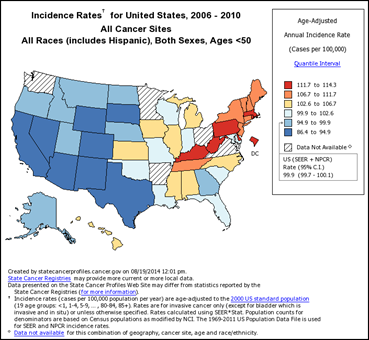
These data do not suggest a temporal or geographic relationship of GM crops to cancers broadly. Using the NCI data you can look for yourself at specific cancers by sex, age, year, race and location. But do keep in mind, as has been addressed in another GMOAnswers response “Will I get cancer?”, that there is no plausible reason to believe that GM crops should alter cancer risk.
GMO Innovation Contest Recap!