Question
How many people get sick per year from eating GMO foods?
how many people get sick per year from eating gmo foods
Submitted by: suk my ass
Answer
Expert response from Community Manager
Moderator for GMOAnswers.com
Friday, 11/03/2016 11:45
In short, the answer is that there have been no documented illnesses or deaths from consuming food from GMO crops. According to the American Medical Association, “there is no evidence that unique hazards exist either in the use of FDNA techniques or in the movement of genes between unrelated organisms. (Report 2 of the council on science and public health (A-12) labeling of bioengineered foods, 2012).”
According to the World Health Organization, “GM foods currently available on the international market have passed safety assessments and are not likely to present risks for human health. In addition, no effects on human health have been shown as a result of the consumption of such foods by the general population in the countries where they have been approved (20 questions on Genetically Modified Foods, 2013).”
We encourage you further to “Get to Know the Health and Safety of GMOs” here.
Take a look at Dr. Denneal Jamison-McClung’s response regarding the long-term health and safety of GMOs and to a similar question “How can you be sure that GMO foods won’t affect human health long-term?”
“…Currently approved GM crops developed through specific genetic additions or subtractions are as safe as conventional and organic crops developed via random genetic shuffling. Most people do not realize that plant breeders have been randomly altering and admixing plant genomes for centuries. Techniques using chemicals and radiation to break plant DNA and induce mutations have been used to develop many conventional and organic crops. Whether plant scientists use traditional approaches or genetic engineering, their goal is to develop crops with new and agriculturally useful traits. Humans have been changing plant genomes for generations—we just have new, more precise, tools…Given that we’ve been genetically modifying plants for millennia, using one approach or another, we should frame this question in terms of relative risks: How ‘sure’ can we expect to be when it comes to long-term health impacts of GMO foods? Like most things in life (except death and taxes, as the saying goes), 100 percent certainty is not possible or reasonable to require. However, safe use of GMO foods since 1996, coupled with our knowledge of human and plant physiology, points to long-term safe use of genetic engineering as a plant breeding tool set in agriculture.”
Dr. Jamison-McClung’s full response is available here.
Catherine Feuillet, head of trait research at Bayer, explains how she is often asked about the safety of GMO foods. She discusses how these foods have to go through scrutiny and regulatory oversight from agencies and authorities around the world before coming to market. A variety of studies have also been performed:
“A 2013 review analyzing the safety of GM crops over the past 10 years demonstrated not only the large amount of studies that have been done on GM crops, but also the lack of detectable hazards directly connected to their use. The Italian authors from the University of Perugia and from the Ministry of Agriculture, Food and Forestry Policies, concluded that GM crops ‘should be considered important options in the efforts toward sustainable agricultural production.’”
For even more information, take a look at the chart below that overviews GM food safety in greater detail.
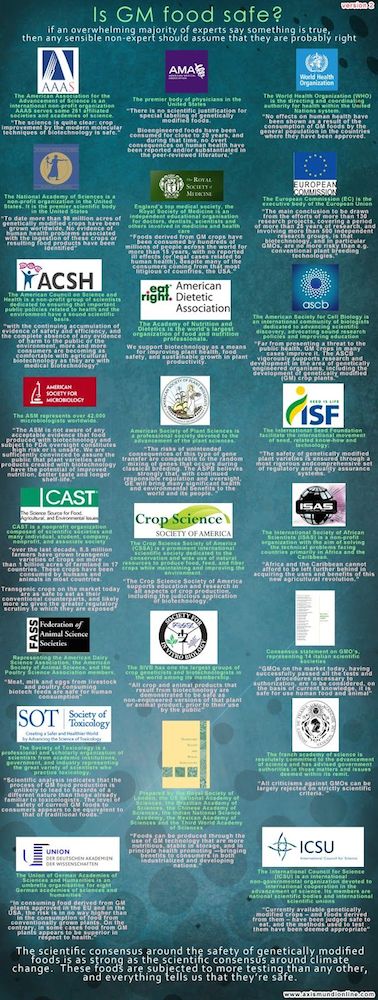
Source: http://gmopundit.blogspot.com/p/450-published-safety-assessments.html
We hope the information provided answers your question. If you have any further questions, please ask. Also, feel free to contribute to the discussion in the comment section below!