ARTICLE: Soil’s Preservation is Essential for Food Security
This article is excerpted from Nebraska Corn Kernels.
 “Soil is a finite resource, meaning its loss and degradation is not recoverable within a human lifespan. As a core component of land resources, agricultural development and ecological sustainability, it is the basis for food, feed, fuel, and fiber production and for many critical ecosystem services. It is therefore a highly valuable natural resource, yet it is often overlooked. The natural area of productive soils is limited--it is under increasing pressure of intensification and competing uses for cropping, forestry, pasture/rangeland and urbanization, and to satisfy demands of the growing population for food and energy production and raw materials extraction. Soils need to be recognized and valued for their productive capacities as well as their contribution to food security and the maintenance of key ecosystem services.
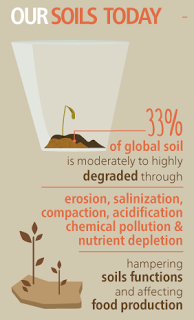
“Soil degradation is caused by unsustainable land uses and management practices, and climate extremes that result from various social, economic and governance drivers. Today, 33 percent of land is moderately to highly degraded due to erosion, salinization, compaction, acidification and chemical pollution of soils. The current rate of soil degradation threatens the capacity of future generations to meet their most basic needs. Current demographic trends and projected growth in global population (to exceed 9 billion by 2050) are estimated to result in a 60 percent increase in demand for food, feed and fiber by 2050. There is little opportunity for expansion in the agricultural area, except in some parts of Africa and South America. Much of the additional available land is not suitable for agriculture, and the ecological, social and economic costs of bringing it into production will be very high. Sustainable management of the world's agricultural soils and sustainable production have therefore become imperative for reversing the trend of solid degradation and ensuring current and future global food security.”