Giving Thanks: What We’re Reading – November 2016
November has come and gone, and across the country, farmers are wrapping up their harvests. This is the season when we gather with family and friends to give thanks for the bounty that has been bestowed upon us.
It is with that feeling of thanks that we look back at the stories we read in November, and show appreciation for the food and agriculture community by highlighting the hard work they are doing to help ensure safe and healthy lives for us and those around the world.
Let’s take a look at a few of the stories that made us feel grateful in November:
Thankful for a Bright Future
There is such potential in agricultural research at the moment, from developing allergy-free peanuts and fortified grape seed flour, to new ways  to pasteurize eggs and test food for bacteria. United States Department of Agriculture (USDA) Secretary Tom Vilsack explains some of the work that USDA and its partners are doing in order to make our food safer, healthier, and more affordable in a new article at Medium, Food and Ag Science Will Shape Our Future.
This investment in research is paying dividends. Vilsack notes, “Studies have shown that every dollar invested in agricultural research now returns over $20 to our economy. For our part, since 2009, USDA has invested $19 billion in research both intramural and extramural. As a result of that investment, research conducted by USDA scientists has resulted in 882 patent applications filed, 428 patents issued and 1,152 new inventions disclosures covering a wide range of topics and discoveries since 2009.”
You can read more about the research being conducted by USDA and by university scientists at Medium. This article on food and ag science is one in a series about the work of USDA. Other essays on agriculture and trade, agriculture helping rural communities, and agriculture helping the environment are also part of this 11-part series.
Thankful for New Technologies That Can Help Save Lives
We’re thankful to live in a society that embraces new technology. Recently, on November 19 one Florida County Board of Commissioners approved a field trial to release Oxitec’s genetically modified mosquitoes in an effort to reduce the population of Aedes aegypti mosquitoes, which can carry Zika and other devastating diseases.
Monroe County, located in the Florida Keys, is gearing up to start the research trial. An article on the NPR website notes that similar trials in 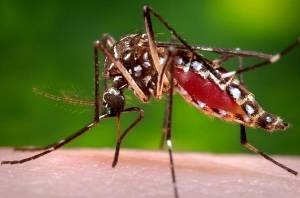 other countries have shown that GM mosquitoes can reduce the population of the virus-carrying species by 90 percent or more. This technology works by inserting a gene into male Aedes aegypti mosquitoes. When the GM mosquitoes mate with females, the offspring will die before they can reach maturity and transmit infection.
While no cases of Zika have been reported in the Florida Keys as yet, local officials want to be prepared with a variety of tools to combat the threat should the virus arrive. The head of the Monroe County health department says that GMO mosquitoes are “a tool available for the people of Monroe County that can help control mosquitoes that carry a very, very, very serious disease." Other areas of Florida have been hit by the virus and will look to the Florida Keys to see how effective this trial is.
Thankful for Being Part of a Community That Is Making a Difference
A recent story in the New York Times reports that university scientists funded by the Bill and Melinda Gates Foundation have genetically engineered tobacco plants to alter the process of photosynthesis. The improved plants experienced an increase in productivity up to 20 percent, a huge margin given that improvements to productivity normally range from one to two percent.
 Although the research was conducted on tobacco, the goal is to replicate this breakthrough in food crops. “We hope it translates into food crops in the way we’ve shown in tobacco,” said Dr. Johannes Kromdijk, one of the researchers. “Of course, you only know when you actually try it.”
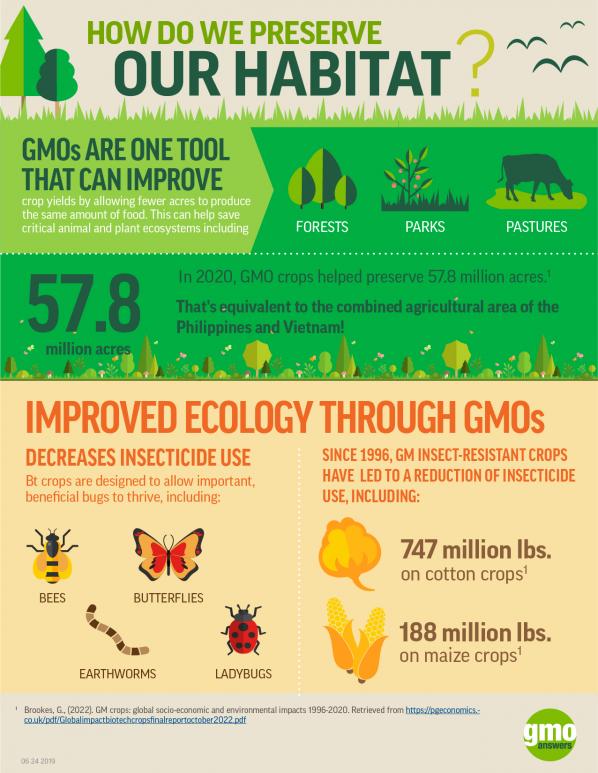
If this discovery can be applied to food crops around the world, a 20 percent increase, or even 40 to 50 percent, which is the ultimate aim of researchers, could have a significant impact on the global food supply. More food could be grown on current or less land, mitigating hunger and helping farmers improve their living standards.
We are very proud to be part of a community that is working to help solve daunting problems, like global hunger, climate change, and poverty. To learn more about this research, visit the New York Times article.
And we are grateful to you for visiting GMO Answers. For more information about GMOs, agriculture, and plant science, please continue to explore the GMO Answers website. Thank you.