ARTICLE: 7 Myths About GMOs That Actually Aren’t True
The following is an excerpt of an article on the website Global Citizen addressing seven myths about GMO technology.
Here’s a look at 7 of the myths trying to end the GMO (just crops) conversation.
GMOs involve unpredictable technology
The name “genetically modified organism” may go down as the worst marketing decision of all time — it’s accurate, but understandably freaks people out. It conjures up images of scientists doing Frankensteiny things in labs. Who would want to eat a genetically modified organism?
In reality, the GMO process isn’t that farfetched. It can be thought of as accelerated selective breeding — when two or more plants are crossbred to produce a desired trait. The key difference is that instead of going through numerous trials of plant reproduction and potentially never arriving at the right conclusion, scientists are able to use sophisticated modeling technologies to know precisely what traits are possible and how to achieve them.
Then very small and contained changes are made to a genome to produce or suppress a trait — more vitamin C, drought resistance, a naturally occurring pesticide, more fiber, for example — and a GMO is made. The result is nearly identical to the original plant on a genetic level. Many GMOs could, theoretically, happen in the wild — it would just take way longer.
GMOs are dangerous to eat
More than 2,000 studies have found that GMOs are safe to eat.
You probably eat GMO foods all the time. Most corn, canola oil, soybean, and so much more, involves genetically modified foods.
All crops grown today went through “genetic modification” of some kind at some point — maybe not in a lab, but in the wild. Plants adapt over time and develop new traits or can be compelled, through human intervention, to develop new traits.
The most popular strain of corn in the world today wasn’t available a few centuries ago. Before it was modified in a lab, farmers bred the crop over time to be more sugary and bland.
Nobody doubts that the corn you see in the grocery store is edible — it may be unhealthy, but it’s edible.
GMOs, similarly, are perfectly safe and edible — there are no risks to eating GMOs. To repeat: more than 2,000 studies confirm this. They may have been changed in a lab, but these changes are all predictable and safe.
There's also a deep irony surrounding this concern — almost all medicine is genetically engineered, yet people still ingest it.
GMOs require more pesticides and chemicals to grow
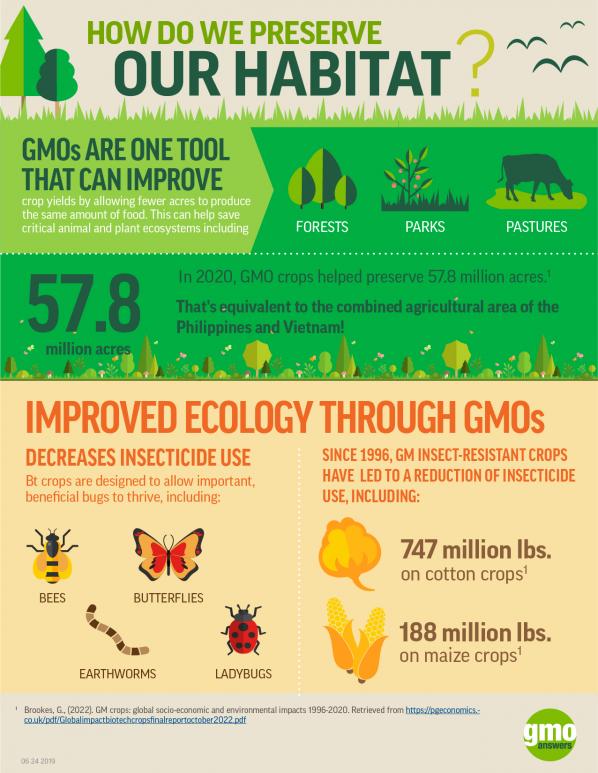
Many GMOs are designed to require less pesticides and chemical assistance to grow. For example, the most common cotton crop in India was modified to repel the bollworm, a pest that would otherwise be devastating and require heavy use of chemicals. All sorts of plants can be equipped with genes that repel pests and other threats in the wild. When a plant is able to repel a pest on its own, less pesticides have to be used.
For GMOs that don’t get traits like this, the amount of chemicals used is no different from what non-GMOs receive.
Read the full list of the myths discussed here.