In November, we read a number of compelling articles on the latest GMO developments and innovations. Here are a few that caught our attention and are still stuck in the Halloween spirit.
Halloween may have passed but the term “Frankenfood” continues to rise from the dead.
FrankenFood. FrankenFish. FrankenPeople?
Did you know: If Frankenstein’s monster were a crop, he’d be a hybrid, not a GMO, and as such could be considered both organic and natural? As the American Council on Science and Health points out, people who take synthetic insulin – created from genetic engineering – are no more “FrankenPeople” than animals who eat GM crops are “frankenstock.”
So why is the “Franken” term used so frequently, and where does it come from?
“The term “Franken-” is thrown in front of a lot of biology that anti-science activists distrust and fear because they do not understand – they behave much like the villagers with pitchforks and torches in Mary Shelley’s horror novel “Frankenstein, or the Modern Prometheus.”
Scary names and incorrect labels are easy ways to instill fear and doubts about GMO safety. But fear and doubts about GMOs can begin to subside after we remove the “Franken” label and take the time to learn about the facts, science and the innovations scientists are developing. Explore the roots of fear surrounding GMOs and biotechnology, in the context of the “Franken” term, in this post from The American Council on Science and Health.
GMO salmon - “FrankenFish” or a solution to the world’s over-fished oceans?
After 20 years of research, development and approvals, the Food and Drug Administration (FDA) approved genetically engineered AquAdvantage® Salmon for human consumption.
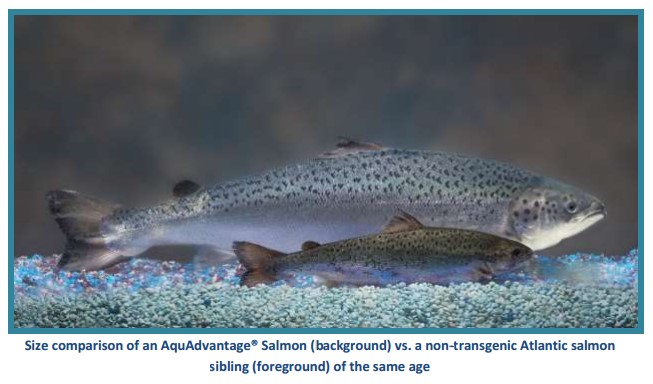
The AquAdvantage salmon has the ability to grow twice as fast, so it reaches market size more quickly, using 25 percent less feed than any Atlantic salmon on the market today. This means more salmon can be produced in less time, with less feed and therefore less environmental impact.
Should we be afraid of this new product of genetic engineering? Dan Farber at Legal Planet isn’t afraid of the new GMO salmon, and here’s why:
“We are massively overfishing the world’s oceans. If we can expand the supply of fish from other sources, we can bring down the price for wild-caught fish and relieve some of the incentives for over-fishing. This kind of “supply side” measure, which tries to protect natural resources by reducing the incentives for over-exploitation, is increasingly important.”
Go beyond the “Frankenfood” grave site, recognize the benefits of GM foods.
What happens when the leading website for lighthearted content takes on the 19 year history of the first genetically modified apple? An amazingly comprehensive but surprisingly understandable post on GMOs, biotech, and consumer opinion.
BuzzFeed reporter Stephanie M. Lee was one of the first people to try the GM, non-browning Arctic apple. Her review?
“Does it taste like a GM food?” he asked me outside his house that day, the last slivers of the Arctic still pale in the summer sun. “Really. Can you distinguish it?” And the truth was, no. It tasted sweet, tender, and crisp. It tasted like an apple.
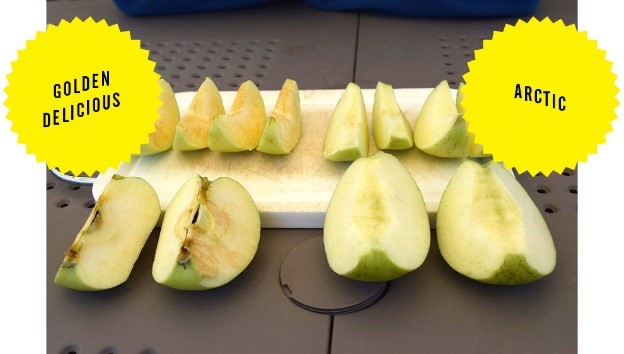
The Arctic apple has already been FDA approved, but even after 19 years of it won’t be available at the supermarket for a few years. Why did Okanagan Specialty Fruits spend 19 years getting an apple that doesn’t turn brown on the market?
Apples are the second-most consumed fresh fruit in the U.S. behind bananas yet an estimated 1.3 billion pounds every year (or a $1.4 billion loss) are thrown away or wasted - with a sizable yet unknown portion due to off-coloring or soft spots.
“The way Carter sees it, the Arctic is a solution to all that: nutritious, attractive, always ready to eat, sliced, dried, juiced, whole. Natural.”
Read the rest of Stephanie M. Lee’s in-depth report on the new GMO apple at Buzzfeed.
Not so scary after all: genetically engineered tomatoes that can produce nutrients.
Although there are no GMO tomatoes that are currently available on the market, scientists at John Innes Centre in Norwich, UK are developing a tomato genetically engineered to make extra substances that protect human cells and improve health.
“A single tomato of the new variety contains the same amount of resveratrol as 50 bottles of red wine, or the same amount of genistein (a compound found in soy beans that is thought to have health benefits) as 2.5kg of tofu.”
Read more of Emma Stoye’s article on this innovative tomato in development at Scientific American.
The “Frankenfood” graves are getting crowded; GMOs are making room for themselves.
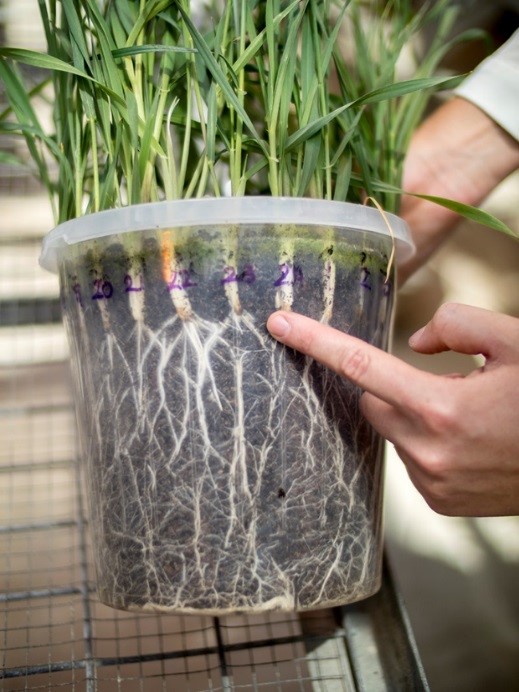 Dr. Lee Hickey of the University of Queensland and his colleagues have identified a gene that causes barley plants to send their roots down, rather than sideways.
Why are downward growing roots better for barley?
Downward growing roots allows barely to extract more water from deep underground. This means that barley crops could better survive and grow in periods of drought.
In addition, by growing downward, the barely roots will conserve energy because there will be less competition with neighboring barley plants for space and water.
Check out the rest of IFL Science’s post on GMO barley here.
And don’t forget to follow our #100DaysofGMOs!
After answering more than 1,000 questions, we launched 100 Days of GMOs. GMO Answers is sharing one question per day of the 100 most asked and accessed questions posted to the website across its social platforms, using the hashtag #100DaysOfGMOs.